
Yifan Xiang
15/8/2025
The production of design works and artistic creations, regardless of period, is invariably intertwined with the dominant intellectual currents of their time—an interrelation that becomes particularly evident within the field of design. A comprehensive understanding of any design thus requires situating it within the prevailing philosophical and ideological frameworks of its historical moment. Accordingly, an inquiry into the evolution of toilet design in China necessitates an examination of the influence of contemporaneous philosophical thought, followed by a critical evaluation of the correlations between those philosophical developments and the conceptual foundations of toilet design
PART I: Ancient Chinese Philosophy and Aesthetics
The dominant currents of ancient Chinese thought largely emerged during the chunqiu period (770–221 BCE), a span of more than five centuries. This era witnessed the flourishing of numerous philosophers and the formation of diverse intellectual schools. Following the decline of the Zhou dynasty, the Central Plains fragmented into a multitude of smaller states, each cultivating distinct cultural and philosophical traditions. Among the most influential were Confucianism, Daoism, and Mohism. This section will focus primarily on Confucianism and Daoism, as both played decisive roles in shaping subsequent cultural development and aesthetic ideals in China.
One of the most consequential figures to arise during this period—not only for China but also for broader East and Southeast Asia—was Confucius. His enduring intellectual legacy is preserved in the Analects, a text compiled by his disciples, which records his teachings and reflections. At the heart of Confucian thought lies the principle of ren (仁), often translated as “benevolence” or “humaneness.” The character shares its pronunciation with ren (人), meaning “person,” symbolizing Confucius’s conviction that a truly human life requires the cultivation of benevolence toward others. He taught that only through the practice of ren could society flourish. As expressed in the Analects: “The ruler governs by means of moral virtue; he stands firm like the North Star, around which the other stars revolve.” Elsewhere, Confucius remarks: “Those who lack benevolence cannot endure adversity for long, nor can they enjoy lasting prosperity. The benevolent remain steadfast in practicing compassion, while the wise recognize its enduring benefits.” These passages reveal Confucius’s belief that moral integrity and benevolence were essential qualities for rulers, nobles, and common people alike, forming the foundation for a more harmonious state.
As Qishao observes, “However, it also created an element in Confucianism that would be returned to in later centuries by new dynasties seeking to impose their will on China and extending Confucian teachings to support their exercise of power—a development associated with Neo-Confucianism.”Indeed, Confucianism was frequently appropriated by successive ruling elites as a tool of governance, precisely because of its emphasis on moral and spiritual cultivation, which lent itself readily to political authority. At the same time, Confucianism must be approached dialectically: on one hand, its hierarchical prescriptions—such as “the ruler must act as a ruler, the minister as a minister, the father as a father, and the son as a son”—placed constraints on individual freedom; on the other, it provided the intellectual foundation for aspects of China’s traditional aesthetic system.
Confucius’s teachings also shaped aesthetic sensibilities in concrete ways. In the Analects, he distinguishes between men of humble origin who pursued education in ritual and music before attaining office, and aristocrats who sought refinement only after acquiring positions of power. He concludes: “If I were to select talent, I would choose those who first cultivated ritual and music.” This highlights his conviction that aesthetic and cultural education was central to human development. For Confucius, a person should not be like a tool—defined by a single function—but should cultivate a broad, multifaceted sensibility.
Throughout Chinese history, Confucianism repeatedly resurfaced as a framework linking inner moral qualities with outward expressions. In the aesthetic sphere, it promoted a shift toward simplicity: objects should not be excessively ornamented but instead return to their essential nature. Yet paradoxically, this very restraint became a marker of cultural identity and aesthetic refinement. As Xiaojing aptly notes: “A development of self-awareness is essential to accomplish this reconciliation, but once achieved, its manifestation can lie in the beauty and utility of artefacts that both reflect the humility of the maker in the face of nature but also the role that the made objects will play in the operation of social order and as useful articles for the pursuit of fulfilling human lives.”
Confucianism and Daoism occupied broadly comparable positions of prominence in Chinese intellectual history. Yet Daoist philosophy and aesthetics exerted a particularly profound influence on design, especially from the Song dynasty onward (as will be discussed later). For this reason, Daoist philosophical thought and aesthetic principles merit a more detailed exploration here.
Daoism is primarily associated with two foundational figures: Laozi and Zhuang Zhou (often referred to as Zhuangzi). While the historical existence of both remains debated among scholars, in this study they will be treated, following traditional understandings, as concrete individuals. The ultimate aim of Daoism is the attainment of the Dao (道). This term, though literally translatable as “way” or “path,” conveys a far deeper and more elusive meaning. The opening lines of Laozi’s Daodejing declare: “The Dao that can be expressed in words is not the constant Dao; the name that can be named is not the eternal name.” The Dao thus resists precise linguistic definition, signifying an ineffable principle that underlies the cosmos.
Central to Daoist thought is an orientation toward nature: nature is placed in the foremost position, with human beings understood as integral components of the natural order. Daoism, in this sense, marked a radical departure from the teleological frameworks of traditional religion. As Xiaojing notes: “It replaces a god-given or teleological view of existence with a view that is centred on human beings and the course (or ‘way’) of their lives. The tao is seen as the flow of the universe and is immanent and ingrained in all aspects of the natural world, of which mankind is a part. The tao is invisible and cannot be measured; it is eternal, ineffable, mysterious, intangible and indescribable. But it transcends everything in the real world, and the concept of ‘transcendence’ is an important one for those pursuing Taoism as a guide to their own lives. Mankind should seek to understand and follow the law or the ‘way’, just as the earth and the heavens do. This is the foundation of the thinking of Lao Tzu.”
From this perspective, Daoism may be understood as an attempt to articulate the laws governing the movement of all things. In Daoist cosmology, the natural order is structured through the triad of Heaven (天), Earth (地), and Humanity (人), and further composed of the five fundamental elements—metal, wood, water, fire, and earth. These elements coexist in dynamic cycles of generation and restraint, through which the world is constituted. The Daoist worldview thus rejects notions of linear accumulation or singular states of being as ideal. Instead, its core principle is balance: all things must counteract and support one another to achieve harmony. The Daodejing illustrates this through metaphor: “Gravity is the root of levity, tranquility is the master of restlessness. Thus even a man of great virtue, though constantly active, cannot dispense with the cart that carries his food and clothing.” This dialectical relationship finds visual embodiment in the Taiji diagram, in which black contains white and white contains black—light within darkness, darkness within light—expressing the interdependent interplay of yin and yang.
Laozi’s philosophy differs from Buddhist asceticism: he did not prohibit the consumption of meat nor the enjoyment of clothing, cuisine, transportation, or shelter. Rather, he emphasized moderation. For Laozi, neither excessive complexity nor absolute rational austerity was desirable; instead, all things ought to exist in proportionate measure.
Equally central to Daoist aesthetics is the notion of emptiness (xu 虚). In Daoist thought, emptiness stands as the necessary counterpart to fullness (you 有). Laozi taught that the cosmos itself originated in a state of void: from this primordial emptiness emerged an undifferentiated qi (气), which separated into turbid and pure forms. The turbid descended to form earth, while the pure ascended to form heaven; from the interaction of the two, the myriad things came into being. This concept of emptiness grew especially influential during the late Song dynasty, shaping aesthetic practices in art and design. In technical terminology, this became known as liubai (留白), or the “art of leaving blank space.” The deliberate cultivation of emptiness invited boundless imaginative engagement, allowing absence itself to become a generative force in aesthetic experience.
Throughout the long history of Chinese aesthetic development, the three dominant traditions—Confucianism, Daoism, and Buddhism—have exerted profound influence. Confucianism, over the course of history, was often appropriated by the ruling elite. This was due in part to its hierarchical structure, in which each social stratum was bound by a distinct set of moral obligations. Such prescriptions rendered Confucianism particularly amenable to governance, offering rulers a ready-made framework for regulating and legitimizing social order.
By contrast, Daoism arguably exerted the most far-reaching influence on Chinese cultural practices. A prime example of this can be found in the field of traditional Chinese architecture, where the concept of fengshui played a decisive role. Rooted in the Luban Jing (Classic of Luban), fengshui posits that human dwellings must be situated in accordance with the natural order so that the vital qi (气)—often understood as the “force of nature”—of human beings may harmonize with that of the environment. This cosmological principle contributed to the distinct rectilinear planning of Chinese architecture, embodying the ancient notion of “heaven is round, earth is square” (天圆地方). For instance, fengshui prescribed that the eldest son should occupy the eastern chamber of the household, as the east was the locus of sunrise and the first emergence of yangqi (阳气). By inhabiting this position, the eldest son would be thought to absorb the first flow of solar vitality, supporting his growth and development.
Daoism, however, influenced not only architectural practice but also aesthetic philosophy more broadly. Within the tradition of Chinese painting, the concept of yi (意)—intention or meaning—holds central importance. Yi refers not only to the artist’s expressive purpose but also to the imaginative possibilities left open for the viewer. In line with the Daoist dialectic of emptiness (空) and fullness (有), Chinese aesthetics often emphasized the generative potential of absence. As with porcelain vessels: while the clay structure provides form, it is the empty space within that endows the vessel with function. The Daodejing cautions against excess: “Too many colors blind the eye; too many sounds deafen the ear; too many flavors dull the palate. Hunting and chasing drive the heart mad, while hoarded treasures lead to theft.” This principle is echoed in Chinese painting, where compositions are deliberately left unfilled, preserving expanses of blank space (liubai, 留白) to invite interpretive freedom. This contrasts with Western oil painting, which often emphasizes narrative density and visual completeness; Chinese aesthetics, by contrast, privileged the evocation of yijing (意境), or the poetic resonance of the scene.
These Daoist principles also shaped approaches to design. Laozi did not oppose ornamentation outright, but he rejected the superfluous and the overly elaborate. For him, true skill did not lie in the mere making or manipulation of tools but in discerning the natural laws of the cosmos and employing them with minimal exertion. This philosophical orientation deeply informed later traditions of product design, particularly during the Song dynasty. Among its most remarkable exemplars was Emperor Huizong, whose achievements spanned painting, calligraphy, ceramics, and the culture of tea. His aesthetic sensibility, informed by the Daoist valuation of emptiness, anticipated the modern dictum “less is more.” By moving away from earlier ornate traditions, Huizong championed clean, refined modes of painting and ceramic design, thereby reshaping the aesthetic logic of Chinese craftsmanship.
Part II: The Influence of Philosophical Ideas on the Development of Toilets in Ancient China
The toilet, as a necessary facility, has since ancient times in China been regarded as unclean, because it was usually associated with odor and impropriety. Therefore, in later documents, examples and replicas of toilet construction were often deliberately avoided, and toilets usually appeared only as auxiliary features in ancient Chinese architecture. However, after the Spring and Autumn and Warring States periods, China entered its first era of unification, the Qin and Han dynasties. At this time, the First Emperor of Qin unified weights and measures throughout the country and established standardized regulations for residential decoration based on the rank of officials[1]. From these regulations, we can also gain a glimpse of the principles that guided the design of toilets.
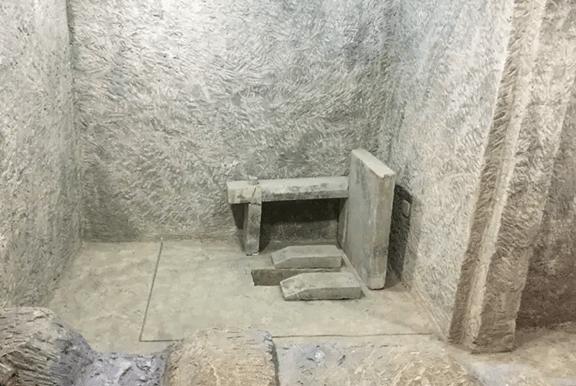
As early as the Banpo site in China, fixed toilets had already been discovered, but these were so-called “dry toilets,” which consisted of a pit dug into the ground; once filled, it was covered with soil. This represents the earliest known form of toilet in China. With further archaeological excavations, the best-preserved ancient toilet to date was found in Shaanxi, built about 2,400 years ago during the Qin state in the Warring States period (Figure 1). This remains the only known archaeological example of a toilet in China, making it the best case for studying how philosophical thought influenced toilet design.
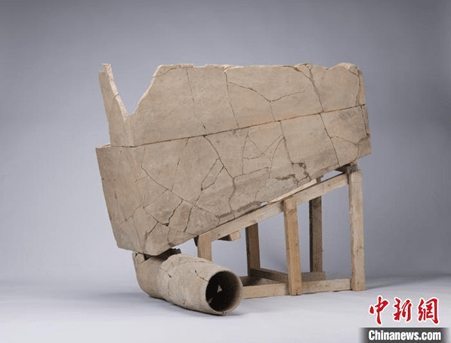
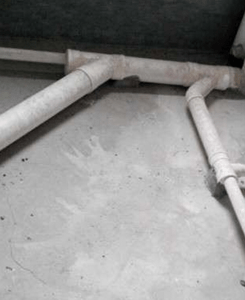
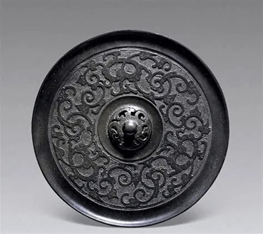
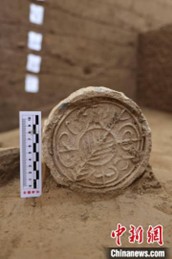
During the Warring States period, especially in the Qin state, the most prevalent philosophy was Legalism. Legalism advocated law as the core of governance, emphasized state power and institutionalized management, and had the most efficient capacity to command armies. In terms of design, it also promoted a principle similar to what we might now call “practicality first.” After Qin unified China, this viewpoint became the mainstream ideology of the time. For example, the drainage pipes discovered in the Shaanxi toilet are already quite similar to those used in modern toilets (Figures 2 & 3). Moreover, no stone carvings or paintings were found inside the toilet, which stands in contrast to the design of other objects of the same period—for instance, bronze mirrors excavated from the same era (Figure 4&5). This indirectly shows that people at the time generally designed utensils with utilitarianism as the guiding principle, aiming to maximize both the efficiency of the object and the user’s experience.

With the development of utilitarianism, the Chinese gradually realized that human excrement had more uses, such as feeding pigs or storing fertilizer. By the late Qin and early Han periods, toilets were often built directly above pigsties (Figure 6). This represented the peak of the “practicality” mindset, but in terms of aesthetic design, it had the opposite effect, because no one would wish to discuss aesthetics or beauty in a place associated with odor, filth, and livestock; people only wanted to finish quickly and leave. Such “non-typical narrative” objects, however, can more accurately reflect people’s aesthetic attitudes and ideas toward toilets as necessary yet dirty facilities, embodying the most direct perception of people at that time.
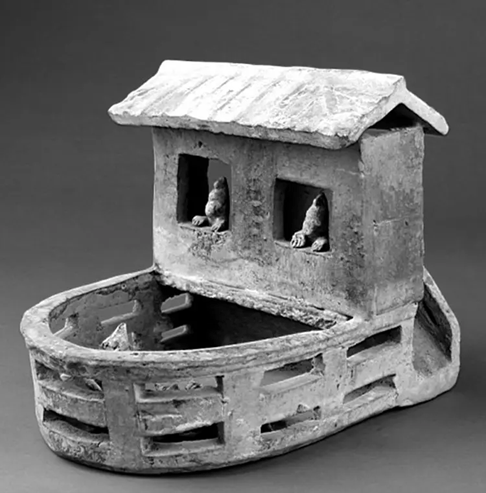
With the passage of time, the influence of Legalist thought gradually began to fade, and people once again started to seek beauty and comfort. By the mid-Han dynasty, people had slowly begun to re-explore comfort and aesthetics. Toilets unearthed from the Western Han period already included flushing systems, and the rear part of the structure was raised to allow users to sit while using the toilet (Figure 7). Around the same time, wooden seated toilets also appeared (Figure 7). The emergence of these objects shows that Legalist thought was gradually diminishing, and people were regaining the right to pursue beauty. This not only reflected a relaxation of political control but also indicated that people’s thinking was slowly turning back toward Confucianism. As Confucius believed, aesthetics and art exert a “profound and powerful” influence on the human spirit, helping people rise from “knowing ren” and “loving ren” to “taking joy in ren” (finding emotional delight and aesthetic pleasure in ren). That is:
- “Those who know it are not as good as those who love it; those who love it are not as good as those who take joy in it” (Analects, Yong Ye).
This indirectly demonstrates that China’s dominant ideology was gradually shifting from the Legalism of the Qin dynasty to Confucianism as the mainstream. In the many years that followed, the development of Chinese toilets continued to evolve alongside advances in productivity and shifts in ideology, reaching a peak during the Song dynasty.
By the Song dynasty, Confucian and Daoist thought had reached their peak, and more and more scholars and literati began to pursue beauty and comfort. They sought a higher form of psychological identification in order to follow their inner sense of elegance and enlightenment. During this era, people’s lives became increasingly enriched, and attention gradually extended to toilets as well.
In the Song dynasty, toilet design reached its height. This is illustrated by a mural depicting a public toilet from the period (Figure 8). In this painting, incense burners were placed inside the toilet, and complete handwashing facilities were provided so that people could wash their hands after use.

This development of toilets in the Song dynasty emerged after significant growth in the means of production. From toilet design, it can be seen that under the centralized system, people’s lives also advanced considerably. Although still influenced by the mainstream ideology of centralized authority, the Song dynasty also saw the rise of many important figures in Confucianism and Daoism, such as Zhu Xi. Their philosophical perspectives were valued by the imperial court, and consequently, they shaped people’s lifestyles, aesthetic tendencies, and design styles of the time.
Song aesthetics emphasized the pursuit of a plain and understated artistic style, which is evident in the large number of Song painting. Song artists widely employed the “freehand brushwork” style to depict objects and landscapes. In design, this approach was amplified: functionality was primary, with only minimal decoration added. This represented the common ground between Daoism and Confucianism—both sought to “experience nature and follow its course.” At the same time, the Song dynasty also promoted the cultivation of one’s moral character and self-restraint, encouraging people to “preserve heavenly principles and eliminate human desires.” Under this intellectual climate, designers and artists minimized the portrayal of human desires. For example, they used the fewest brushstrokes to convey the deepest artistic conception, enabling the human heart to directly sense the “meaning” (yi) and “vital energy” (qi) of nature.
In toilet design during the Song dynasty, this principle was also followed. Designers avoided excessive ornamentation and intricate carvings, instead using landscape paintings extensively for decoration. It was believed that such paintings could generate more qi, allowing people to perceive the movement of all things and gradually comprehend the presence of the Dao.
In this Confucian- and Daoist-dominated era, designers adopted a completely different way of constructing narratives. In this larger narrative process, they did not approach design by deconstructing and depicting the object itself, but rather by starting from utilitarian principles and allowing people to gradually sense the “meaning” (yi) within design. This yi did not simply signify “meaning” in a literal sense—it also conveyed the designer’s state of mind and their habitual “observation and analysis” of the universe’s movements. People were encouraged to ponder the concrete significance of yi: it could represent the psychological activity of the designer during creation, or their observation of the motion of all things in the world. At the same time, influenced by mainstream cultural thought, designers gradually developed the habit of contemplating the Dao and preferred to convey their inner state in implicit ways. Under this narrative framework, design was thus primarily an expression of practicality and of the designer’s yi, rather than of emotions or of the object itself.
By the Yuan dynasty, China was no longer ruled by the Han people; instead, power was in the hands of the nomadic Mongols. As a result, much of the Han ruling ideology and cultural traditions were eradicated during this period. Due to the Yuan dynasty’s large-scale military campaigns and the heavy taxation imposed on residents, the status of toilets was thoroughly diminished. People returned to the simplest form of defecation—digging a pit in the ground and covering it with soil once it was filled, the so-called “dry toilet” model.
By the Ming dynasty, the Han people regained political power. However, during this period, the Ming dynasty fell into a phase of explosive population growth. Urban populations expanded rapidly, and the excessive excrement was left within the cities without proper transport, leading to deteriorating sanitary conditions for city residents. Meanwhile, in the imperial palace, Daoist thought and the concept of “feng shui” were once again mentioned. In The Classic of Lu Ban (Lubanjing), there was no reference to the feng shui of toilets, and other feng shui texts such as Qimen Dunjia also made no mention of the proper placement of toilets. As a result, toilets as independent spaces were not given importance during the Ming dynasty. In the construction of the Forbidden City, there was no designated place specifically for toilets. The act of relieving oneself became an activity without a fixed location. When nobles needed to use the toilet, servants would bring a special chamber pot and chair (Figure 10&11), allowing them to relieve themselves wherever they were. After use, the chamber pot would be collected and transported to a designated area within the palace for cleaning.

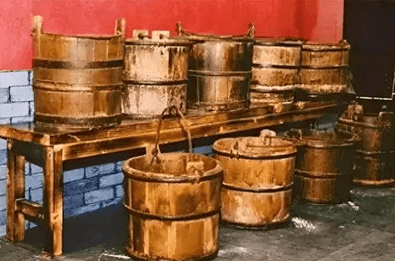
During the Ming and Qing dynasties, the role of the toilet as an indoor space gradually faded. Even within the Chinese imperial courts, which were otherwise renowned for luxury, the chamber pots used for defecation were nothing more than plain wooden buckets, devoid of any ornate decoration.
Influenced by the waves of traditional Chinese cultural thought, architectural design gradually returned to Daoist traditions. However, during the Qing dynasty, the emperors were not Han but Manchu. Although the Forbidden City, originally built in the Ming dynasty, remained in use, its interior decorative style was transformed to reflect Manchu aesthetics. This caused Qing design to deviate from the Confucian and Daoist framework and to become increasingly imbued with Manchu ethnic characteristics. Even in the domain of toilets—a space traditionally “neglected” by the Chinese—design diverged from the principles of Confucianism and Daoism.
The design of toilets in ancient China rose and fell with the shifts in prevailing thought. In times of advanced productivity and flourishing culture, toilet design kept pace with the development of people’s ideas. However, when eras of warfare or cultural hybridity arrived, toilets—as a kind of “marginal” facility—were forgotten in the corner of design. At the same time, toilets could effectively reflect the level of cultural and intellectual development of a given era. Toilets, often regarded by the Chinese as “ancillary” to architecture and daily life, more vividly revealed the evolution of social thought at the time. Toilet design functioned like a mirror: it not only reflected the development of Chinese lifestyles but also more profoundly revealed the progression of ideas and the degree to which individual thought and personality were valued.
Bibliography:
Aa, Inna. Archaeological discoveries in Shaanxi Province have revealed a “flush” toilet dating back approximately 2,400 years,
Cheung, Leo K. C. “THE METAPHYSICS AND UNNAMABILITY OF THE ‘DAO’ IN THE ‘DAODEJING’ AND WITTGENSTEIN.” Philosophy East and West, vol. 67, no. 2, 2017, pp. 366
Gentz, Joachim. “Mohist Traces in the Early ‘Chunqiu Fanlu’ Chapters.” Oriens Extremus, vol. 48, 2009, pp. 55–70.
Hattori, Unokichi. “Confucius’ Conviction of His Heavenly Mission.” Harvard Journal of Asiatic Studies, vol. 1, no. 1, 1936, p. 98
Qian, Mu. (钱穆),《The outline of Chinese history(国史大纲)》(1991),Beijing. The commercial press,1991:P73. ISBN 7-100-01766-1.
Langlois, John D. “Chinese Culturalism and The Yüan Analogy: Seventeenth-Century Perspectives.” Harvard Journal of Asiatic Studies, vol. 40, no. 2, 1980, pp. 355–98.
The palace museum, https://gugongzhanlan.dpm.org.cn, accessed at 11/5/2025
Shao, Qi, Wen, X., White, P. Design Ideas Before the Qin Dynasty. In: A Brief History of Chinese Design Thought. (2022). Springer, Singapore.
Shandong museum, https://www.sdmuseum.com/col/col270803/index.html access at 10/8/2025
Wei, Chiao. “Daoism in China.” Religion in China: Major Concepts and Minority Positions, edited by Max Deeg and Bernhard Scheid, 1st ed., Austrian Academy of Sciences Press, 2015, pp. 16
Zhang, Shining. The Five Mountains and Ten Monasteries Map and the Zen temples in Jiangnan during the Southern Song Dynasty(2000), Southeast University Press, P48
《大清高宗纯皇帝实录》卷一二八
 Fan’s portfolio