
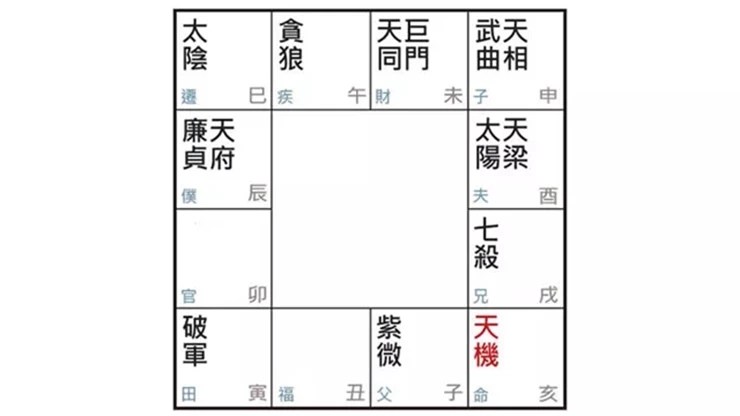
Ziwei Doushu, as a traditional Chinese system of astrology and fate calculation, is developed through the combination of astronomy and geography. Unlike the traditional Bazi (Four Pillars of Destiny), this method integrates both time and location. However, it is also relatively difficult to learn. In the beginning, it is not too hard to understand, but as one delves deeper, various complexities are added, making the learning curve much steeper.
1. Charting (Pai Pan)
In Ziwei Doushu, the chart is divided into twelve sectors, representing twelve star regions. The astrological chart is derived from the view of the sky at your birthplace and birth time. Starting from the third square in the bottom row (which corresponds to the Zi hour, 11 p.m.–1 a.m.), the chart circles around into twelve sectors, each known as a Palace. Next, the Heavenly Stems (Tiangan) are arranged according to the birth hour. Since there are only ten Heavenly Stems, two of them will inevitably repeat.
Then comes the determination of the Life Palace (Ming Gong). First, the birth month is identified, and then the hours are counted backward to locate the position of the Life Palace.
Once the Life Palace is fixed, the names of the other Palaces are read clockwise: Parents Palace, Fortune & Virtue Palace, Property Palace, Career Palace, Friends Palace, Travel Palace, Illness Palace, Wealth Palace, Children Palace, Spouse Palace, and Siblings Palace.
2. Determining the Star Chart
This part is too complex to explain in detail—so using software is recommended.
3. Reading the Chart
The first step in reading the chart is to look at the Life Palace. Start with the Main Star(s)—each star has its own meaning (explained later). Then, analyze it together with the opposite Palace (Travel Palace), the Career Palace, and the Wealth Palace to get an overall picture of the person’s life fortune. If you want to focus on a specific area of their life, treat that Palace as the Life Palace and apply the same principles. The logic is simple.
4. Transformations of Fortune (Hua)
Beneath the stars, there are often marks (guided by mnemonic verses):
- Hua Lu (Transformation of Prosperity) represents wealth.
- Hua Quan (Transformation of Authority) represents power.
- Hua Ke (Transformation of Prestige) represents studies/academics.
- Hua Ji (Transformation of Obstruction) represents things to avoid.
Major Stars:
Ziwei (Emperor Star), Tianji (Heavenly Machine), Taiyang (Sun), Wuqu (Military Authority), Tiantong (Heavenly Child), Lianzhen (Integrity), Tianfu (Heavenly Treasury), Taiyin (Moon), Tanlang (Greedy Wolf), Jumen (Great Gate), Tianxiang (Appearance), Tianliang (Beam of Heaven), Qisha (Seven Killings), and Pojun (Army Breaker).
There are also the Six Auspicious Stars: Wenchang (Literary Elegance), Wenqu (Artistic Talent), Zuofu (Left Assistant), Youbi (Right Assistant), Tiankui (Nobleman), Tianyue (Heavenly Support).
And the Six Malefic Stars: Huoxing (Fire Star), Lingxing (Bell Star), Dijie (Earth Robbery), Dikong (Void of Earth), Qingyang (Sharp Horn), Tuoluo (Obstruction).
In addition, there are supporting stars such as: Lucun (Wealth Storage), Tianma (Heavenly Horse), Tianku (Heavenly Cry), Tianxu (Void), Hongluan (Red Luan), Tianxi (Heavenly Happiness), Tianxing (Punishment), Tianyao (Flirtation), Xianchi (Peach Blossom), Huagai (Canopy), Guchen (Solitary), and Guasu (Widowhood), among others.
Furthermore, four Transformational Stars must be considered: Hualu (Prosperity), Huaquan (Authority), Huake (Prestige), and Huaji (Obstruction).
Roughly speaking, with the 14 Major Stars plus the Six Auspicious Stars, Six Malefic Stars, Four Transformational Stars, Lucun, Tianma, etc., there are about thirty or so stars in total. Stars below the level of Tianma move depending on the Major Stars, and their presence or absence does not significantly affect the judgment of fortune or misfortune. Therefore, learners may freely choose which auxiliary stars to include, and the total number is not strictly necessary.
Meanings of the Major and Auxiliary Stars
- Ziwei (Emperor Star): Represents the emperor; think of historical kingship.
- Tianji (Heavenly Machine): Useful for spreading knowledge and communication.
- Taiyang (Sun): Warm, generous, proactive; in weak position, turns selfish.
- Wuqu (Military Authority): Decisive, upright; pursues wealth.
- Tiantong (Heavenly Child): Childlike personality; easygoing and sociable.
- Lianzhen (Integrity): Honest, loyal, responsible; high self-demand.
- Tianfu (Heavenly Treasury): Capable and conservative.
- Taiyin (Moon): Gentle and affectionate.
- Tanlang (Greedy Wolf): Strong material desires; good at relationships; indulges in pleasures of life.
- Jumen (Great Gate): Strong inclination toward speech; tends to worry and be uneasy.
- Tianxiang (Appearance): Cautious, detail-oriented, values image.
- Tianliang (Beam of Heaven): Values ethics and religious or moral reflection.
- Qisha (Seven Killings): Rational, diligent, sincere, courageous, persistent—likened to a general, embodying wisdom, trust, benevolence, courage, and discipline.
- Pojun (Army Breaker): Full of changes and unpredictability.
Auspicious and Supporting Stars
- Wenchang: Formal studies such as literature, languages, mathematics.
- Wenqu: Talents in arts: music, painting, divination, performance.
- Zuofu & Youbi: Good friends—acceptance, tolerance, cooperation, closeness.
- Tiankui & Tianyue: Noble temperament; benefactors.
Malefic Stars
- Huoxing (Fire): Impulsive, explosive.
- Lingxing (Bell): Bold, persistent.
- Qingyang: Like a blade—can harm others or oneself.
- Tuoluo: Stagnant, indecisive.
- Dijie & Dikong: Go with intuition and feelings first, everything else follows.
Other Auxiliary Stars
- Lucun: Holding fundamental resources; can attack or defend, a foundation of wealth.
- Tianma (Heavenly Horse): Restless, constantly on the move.
Four Transformational Stars
- Hualu (Prosperity): Smoothness, enjoyment, gains.
- Huaquan (Authority): Firmness, persistence, control.
- Huake (Prestige): Reputation, scholarship, vanity.
- Huaji (Obstruction): Hindrance, misfortune, change, hardship, destruction.
 Fan’s portfolio